
If you’ve ever looked “put together” on the outside while feeling scattered on the inside, you’re not alone. In this week’s Designing in 5D, Jodi talks with Gemma Price, a Master Intuitive Psychology Coach and award-winning CEO, about how aligning your inner world with your outer environment changes everything—from your energy and focus to the way your home actually feels. Understanding the psychology of space can enhance this alignment further.
This isn’t about doing more. It’s about designing with intention so your space starts doing some of the work for you.
This insight into the psychology of space allows us to create environments that nurture our well-being.
Routine vs. Ritual (and why it matters)
Routines run on autopilot. Rituals run on intention. When we reframe everyday moments—a morning coffee, opening the laptop, turning down the bed—as small rituals, we tell the nervous system, you’re safe; you can soften here. That shift reduces background anxiety and helps you access intuition more easily.
Try this: Before you start email, place one hand on your heart, take three slow breaths, and name your intention for the next 30 minutes. Then begin. It’s 20 seconds that changes the tone of your day.
Nervous-system-friendly design cues
Your home constantly sends signals to your brain. Design them on purpose:
-
Light: Prioritize natural light by day; dimmable, warm layers by night.
-
Color & texture: Earthy, desaturated tones; tactile linens, wood, boucle—materials that read “calm.”
-
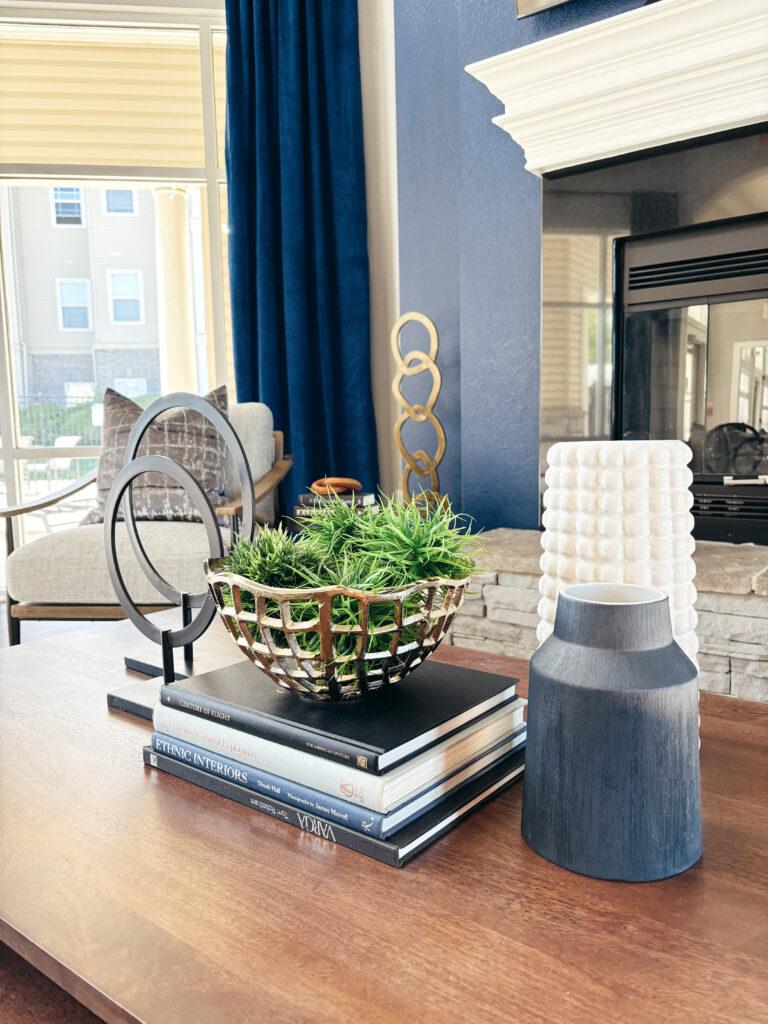
Nature: A plant within your peripheral view lowers stress. So does a bowl of water or small fountain (sound + movement).
-
Scent & sound: One grounding scent for focus work; a different one for evening wind-down. Use a consistent playlist to anchor the state you want.
-
Visual load: Edit surfaces. Corral remotes, chargers, and mail into dedicated trays so your eyes rest.
“I don’t want the critical voice designing my space. I want the voice that knows what feels good.” — Gemma Price
Decision fatigue, solved
If you make a thousand choices for everyone else, create guardrails for yourself.
-
Default palette: Choose a base palette for your home (3–4 colors + metals). All future selections pull from it—fewer tabs, faster yes/no.
-
Zones: Define where things live (drop zone, charging drawer, project basket). Decision fatigue plummets when the answer is pre-decided.
-
Kits: Bath “reset kit,” hostess kit, gift kit, travel kit—pre-packed bins that remove last-minute scrambling.
-
The 2-Tray Desk: One “current project” tray and one “inbox” tray. Everything else gets filed or recycled.
Inner work that supports outer change
Clutter is often a conversation your nervous system is having with the past. A few tools we love (and discuss in the episode):
-
Un-layering prompts: “What’s beneath this feeling?” Ask again and again until you land on the root.
-
Inner-child check-in: Look at a childhood photo. Offer a sentence of care out loud. Notice what softens.
-
Body cueing: “How does my left foot feel?” It sounds funny—but it snaps the brain from rumination into presence.
A 10-minute reset ritual
-
Step outside; feel your feet on the ground (1 min).
-
Box breathe: 4 in, 4 hold, 4 out, 4 hold (3 min).
-
Write one sentence: “For the next hour, I choose ___.” (1 min)
-
Tidy one surface you’ll see all day (3 min).
-
Place an anchor object (a stone, leaf, or crystal) by your keyboard to remind your body: safe, present, here (2 min).
Start small: 7 days to lighter living
-
Mon: Clear one drawer.
-
Tue: Swap harsh bulbs for warm, dimmable lamps.
-
Wed: Place a plant where you work.
-
Thu: Curate a 30-minute “focus” playlist.
-
Fri: Make a 3-item “Not Doing” list.
-
Sat: Create a drop zone by the door.
-
Sun: Build a bedtime ritual (lights low, lavender, no blue light for 30 minutes).
When design becomes healing
Design isn’t just how a room looks—it’s how your nervous system behaves inside it. When your space affirms who you are (and who you’re becoming), you stop chasing and start attracting. That’s the heart of livable luxury: beauty that works for your life.